
World Day for the Care of Creation
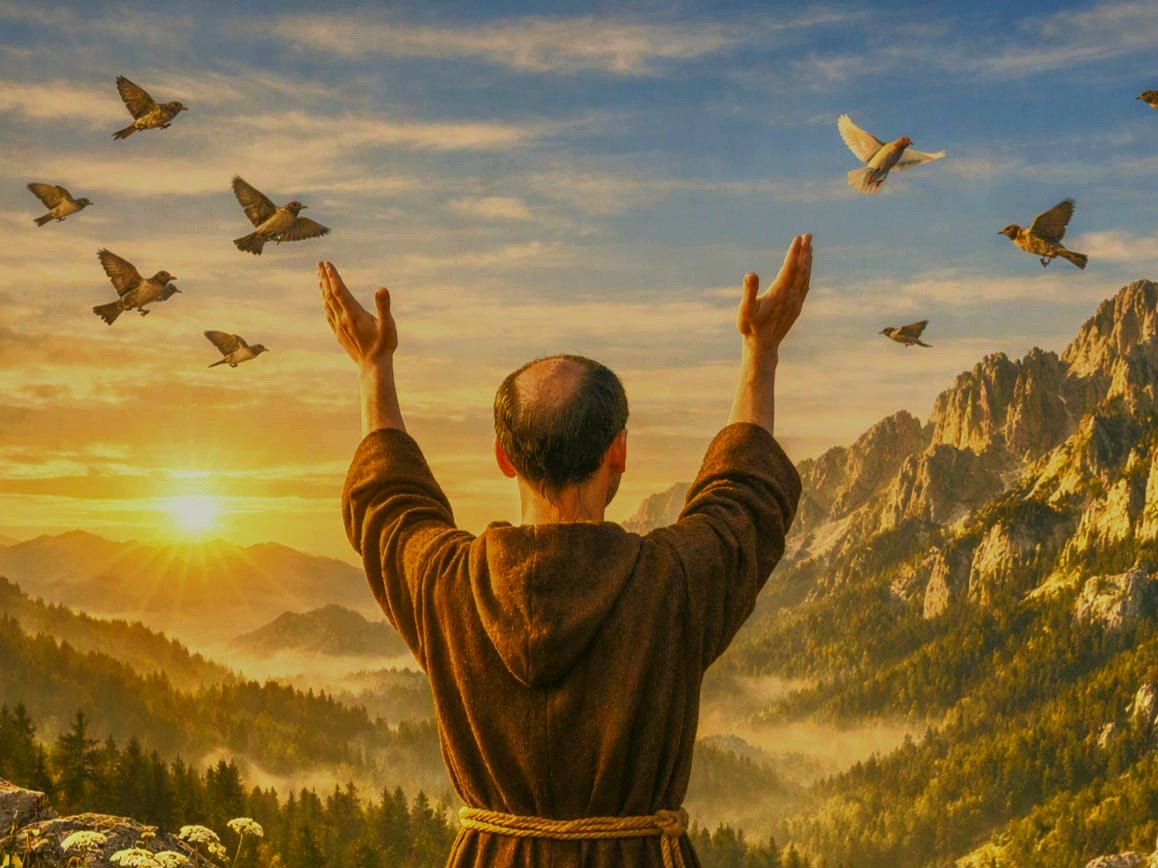
They finally reached the foot of the mountain. Before beginning their climb, they rested for a few hours under a lush evergreen oak. What took place at that moment defies explanation. Within minutes, hundreds of blackbirds, larks, robins, nightingales, sparrows, thrushes, finches, and even partridges appeared. Brother Francis, profoundly moved and grateful, repeated:
–“Thank you, Lord, thank you!”
Never had they seen anything so festive. The birds whistled, chirped, sang, and fluttered about Francis in joyous pandemonium. Some performed lovely pirouettes and dizzying acrobatics, while others perched on his head, his shoulders, his arms, and on his knees. It was a festival of song and dance.
–“Brother Leo, what marvel, what wonder! God is great!” exclaimed Francis, completely overwhelmed by the spectacle, adding: “All we need are the swallows and Alvernia will be covered in the colors of spring.”
They climbed the rocky slopes. Francis’ eyes were opened wide with amazement. It was as if he were viewing the slope for the first time. He felt as if he were witnessing the beginning of creation: everything was new. Immense spruce trees, firmly planted in the rocky earth, seemed to touch the sky, and they were so wide that not even four men could circle its diameter.
Francis asked the muleteer to detain the donkey. Poised at the foot of one of the spruce trees, he threw his head back and shaded his eyes with his hands as he contemplated the spruce from top to bottom. After admiring it for a long while, he exclaimed:
–“Lord, Lord, how great you are!”
As they climbed, the panorama began to widen before them. Immense beech trees, mighty evergreen oaks, and tall pines of a rare variety created fresh and enormous shadows. Francis felt as if he were in paradise.
–“Brother Leo,” he exclaimed, “what peace! What freedom! What joy! We are the happiest men on earth.”
Upon nearing level ground, Francis felt the need for solitude and manifested his wishes to his brothers. He entered a wooded area and walked in all directions. Afterwards, he descended about five hundred feet. He stood before the rocky terrain, his back to the setting sun. What a sight! It is difficult to find words evocative of God’s power and timelessness.
Savage rocks encrusted the mountain; their peaks pressed against the blue firmament. Bathed in golden sunlight, they resembled the blazing fires that erupted in an era long ago. Everything was ablaze on that mountain.
–“Bolts of lightning must have created these deep fissures,” Francis thought to himself. “What earthquake could form such colossal structures? This must have occurred when the earth protested the death of Jesus.”
Francis was overwhelmed as he repeated aloud:
–“Lord, Lord!”
The infinite weight of God’s sweetness fell upon Francis’ soul. This solace freed Francis from himself and fueled his energies, and with renewed vigor he knelt before the gigantic rocks, extended his arms, and exclaimed in a loud voice:
–“Almighty God, although I am unworthy to say your name, I dedicate this song to you.
“Lord, Lord, eternal master of the endless horizons!
“You’re as beautiful as the landscape, as invincible as these rocks, as eternal as this mountain, as deep as the blue above.
“You have created these rocks, these powerful sentinels, to guard the passing of time.
“My soul feels you and loves you amidst the fires of these peaks.
“Everything is full of your presence. You will shine forever on the rocks of my soul.
“May you be blessed for the power of this eternal mass of rock.
“May you be blessed for its brazen fissures.
“May you be blessed for the eternal snows.
“May you be blessed for the august silence of starry nights.”
Taken from the book “The Brother of Assisi” Chapter VI, Subtitle “Alvernia in Sight”, by Father Ignacio Larrañaga